Field report 01 · Healthcare · Pilot
A well-being pilot for 32 medical students and 16 clinicians. Then the whole school.
Short weekly check-ins for students, plus a 60-second meeting agenda so busy physician mentors showed up prepared. Uzair designed, built and deployed it as founder of DistrictZero.
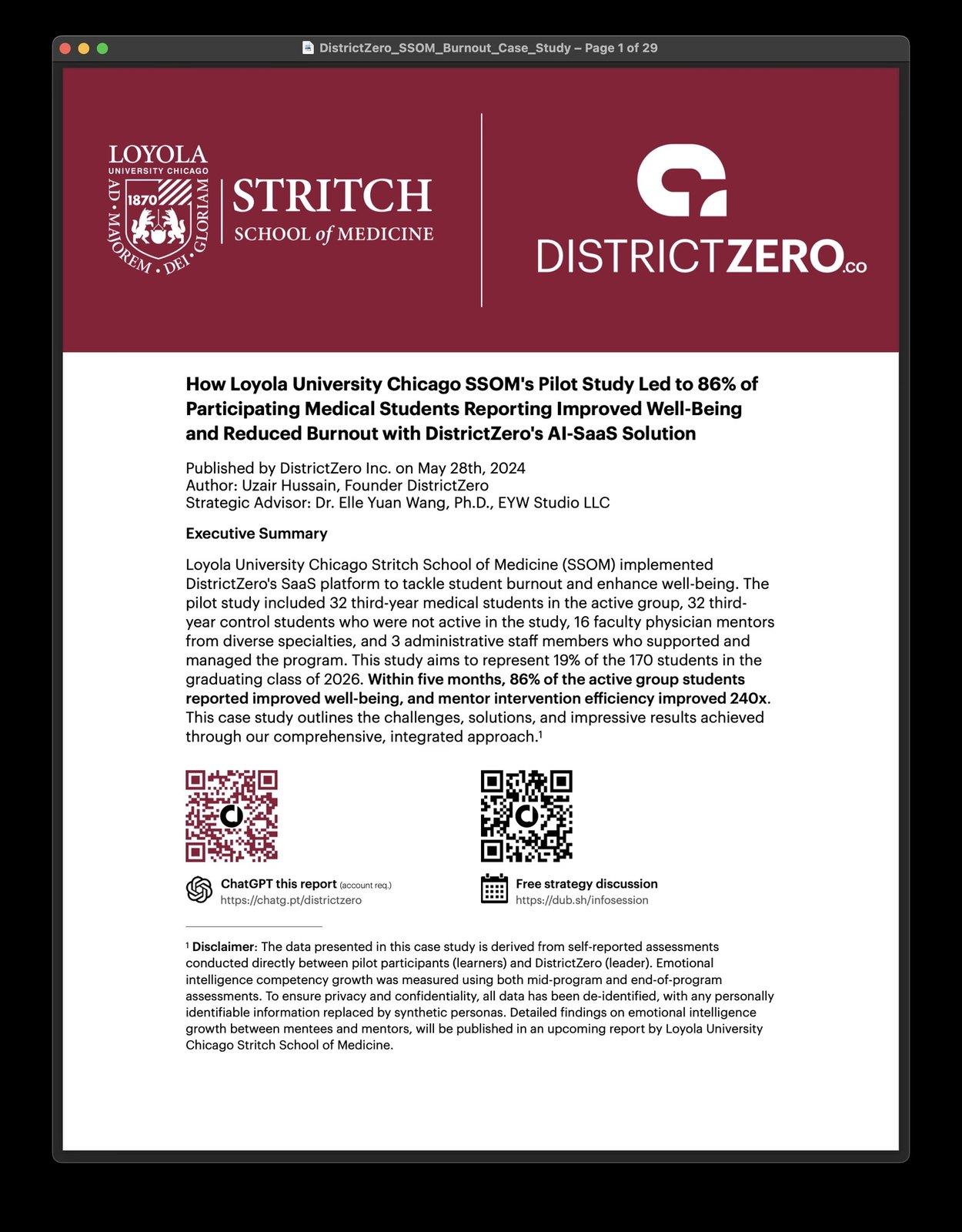
A one-page PDF of this field report.
- Client
- Loyola University Chicago Stritch School of Medicine
- Team
- Leischner Department of Medical Education
- Role
- Founder, product and AI engineering
- Privacy
- Student data protected, research-board approved
- Participants
- 32 students, 16 clinician mentors, 32 controls
S1The situation
Burnout in third year. Clinicians short on time.
Loyola wanted spaced mentorship for third-year students: frequent, short check-ins with a faculty physician mentor. But clinicians give only a small slice of their week to teaching, and meeting prep ate into it.
S2The one outcome
Show that spaced mentorship improves well-being in one semester.
Measured against a control group with the Oldenburg Burnout Inventory, the Perceived Stress Scale and a Quality of Life Scale.
S3What we built
A check-in loop busy mentors could keep up with.
- Weekly student check-ins, adapted from DistrictZero's K-12 model for adult emotional intelligence
- An agenda generator that turns a week of check-ins into a meeting plan in about 60 seconds
- Safety alerts across 11 categories, routed to the Cuneo Center's campus resources
- Simple, private sign-in, approved by Loyola's research review board
Built for 16 clinicians
Their teaching time is small. It is also the time that shapes the next doctors.
Each physician mentored two students. Instead of reading a week of check-ins before every meeting, they opened an agenda DistrictZero had already drafted: wins, challenges and next steps.
Check-ins
Short and weekly, from each student
AI synthesis
Themes, emotion insights and safety signals
60 seconds
To a structured meeting agenda
“The agenda generator is an element that has the potential to modernize the mentorship process. It literally does the work for the mentor.”
Chair, Leischner Department of Medical Education, Loyola University Chicago Stritch School of Medicine
From the students
In their own words.
Third-year students in the pilot, describing what changed for them.
“Having someone to talk to made me feel emotionally supported.”
Third-year student “I felt more confident and less stressed about my clinical rotations.”
Third-year student “As the program progressed, my well-being ratings consistently improved.”
Third-year student
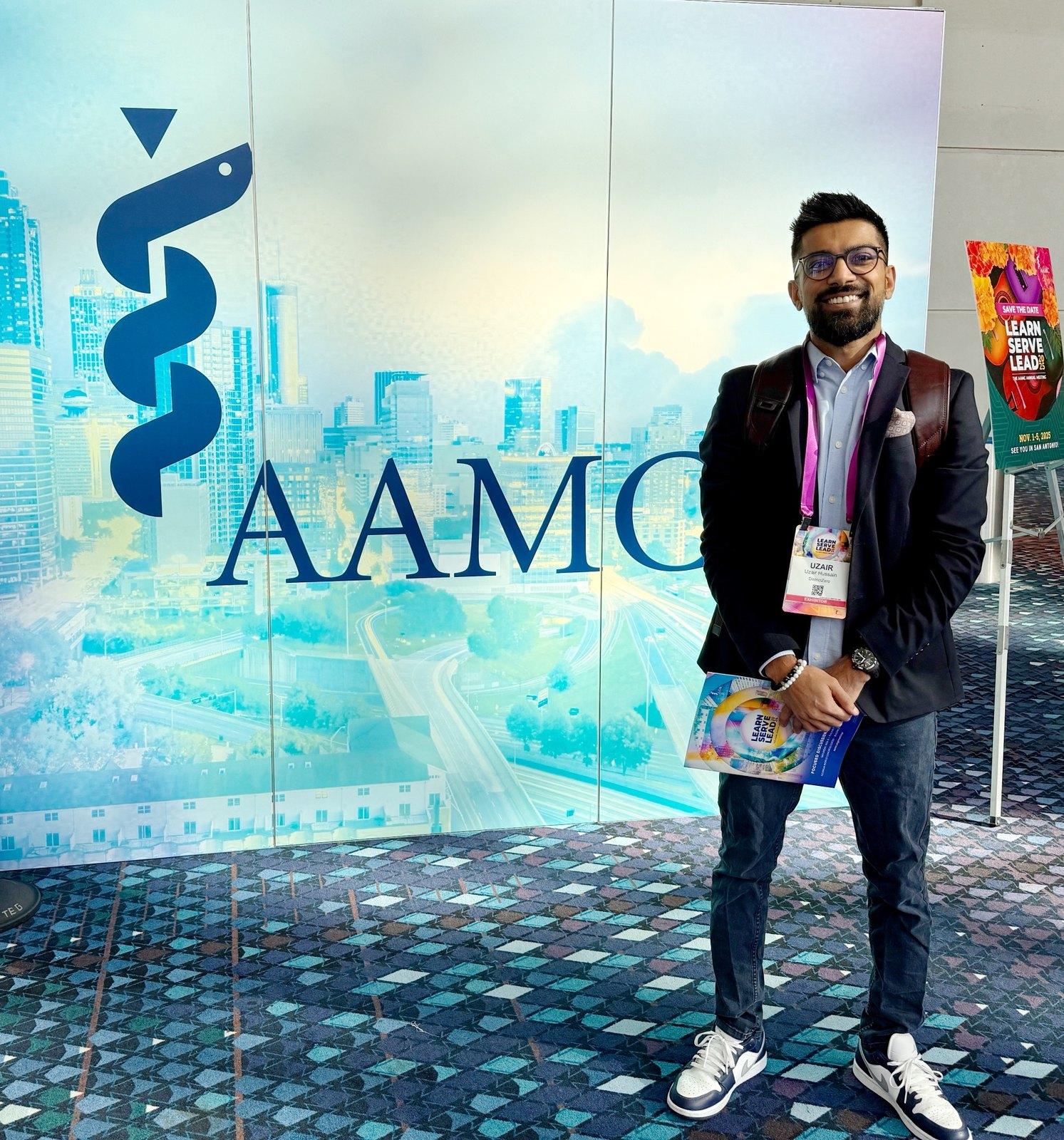
On the floor · Learn Serve Lead 2024 · Atlanta
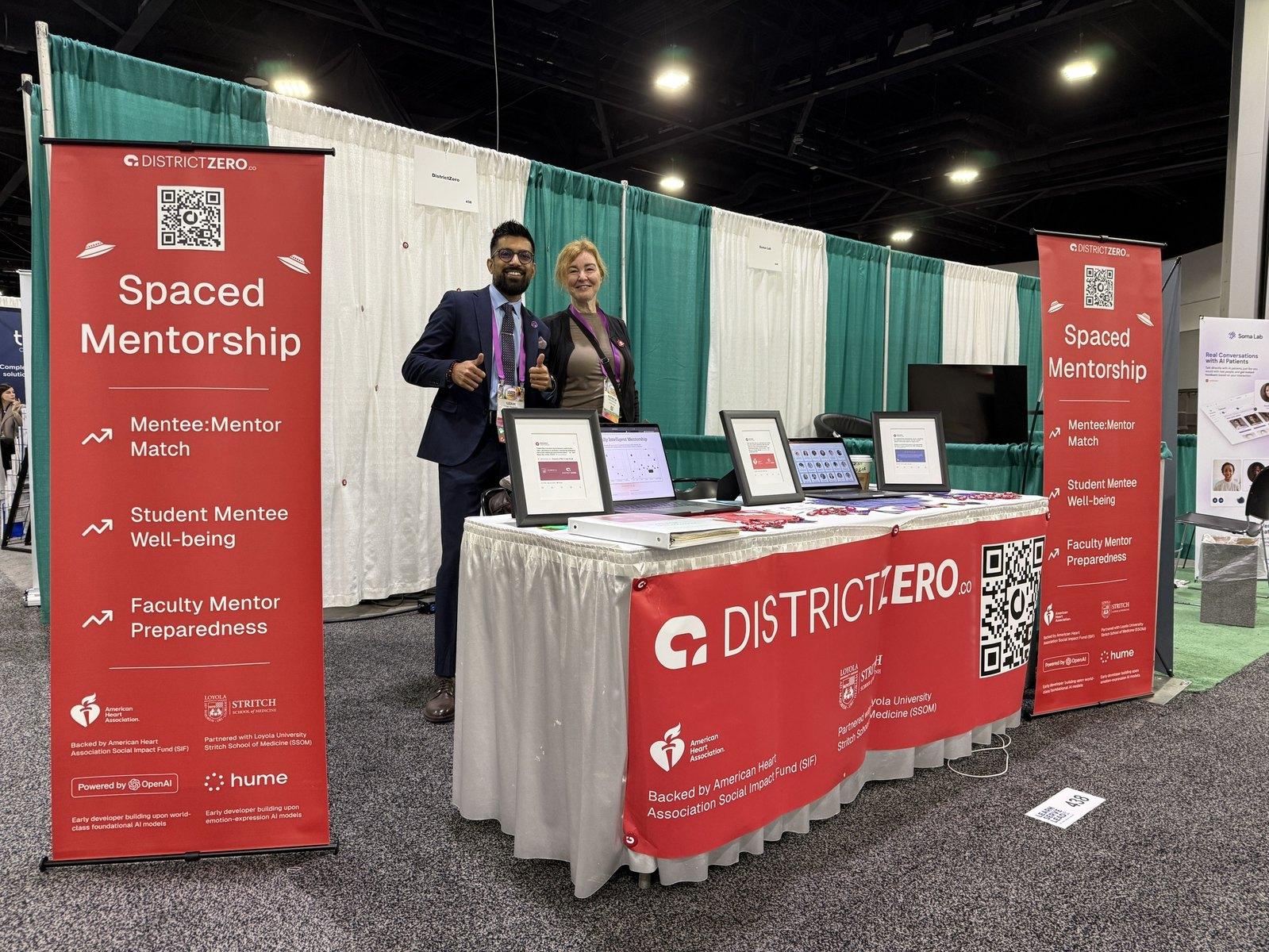
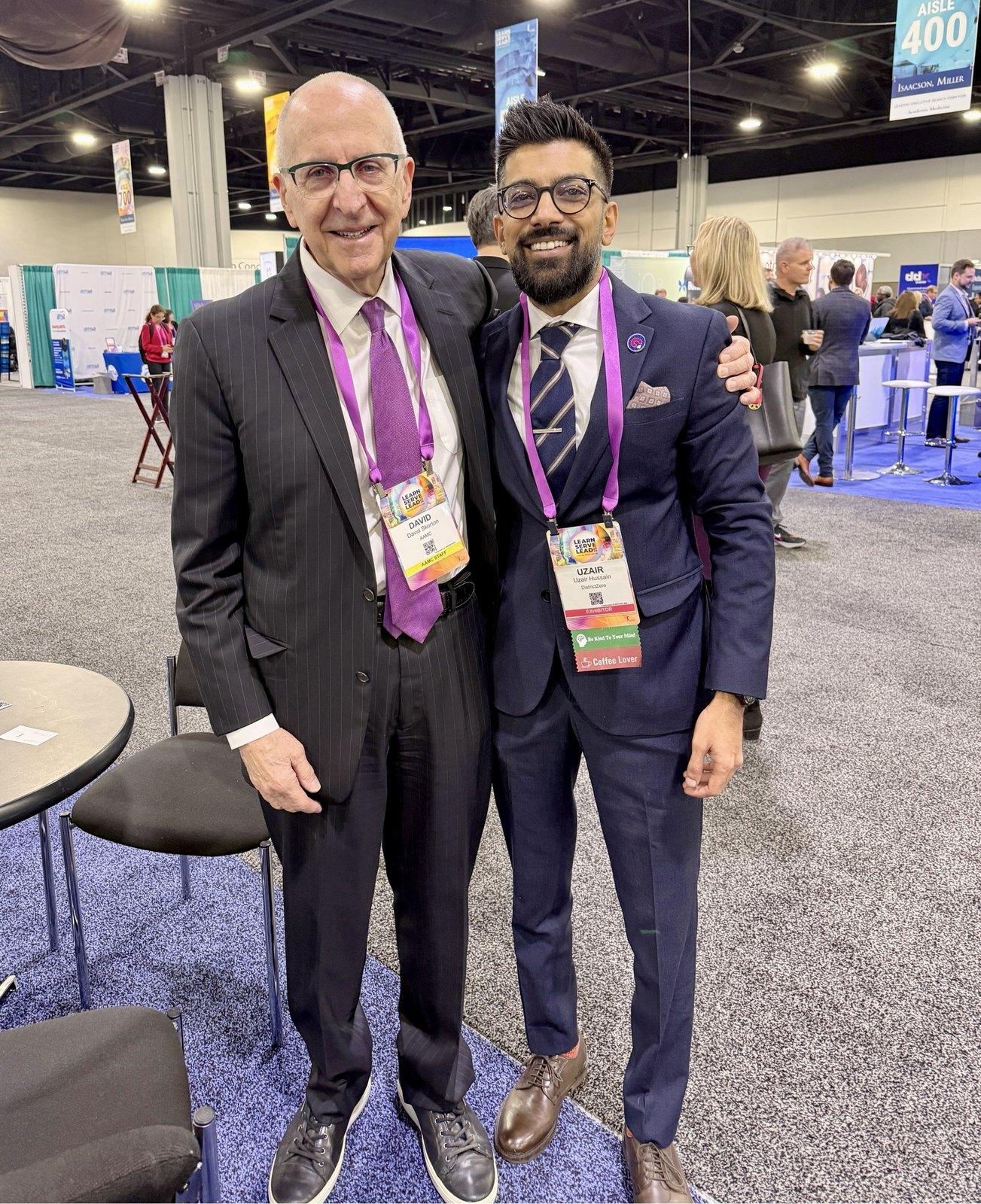
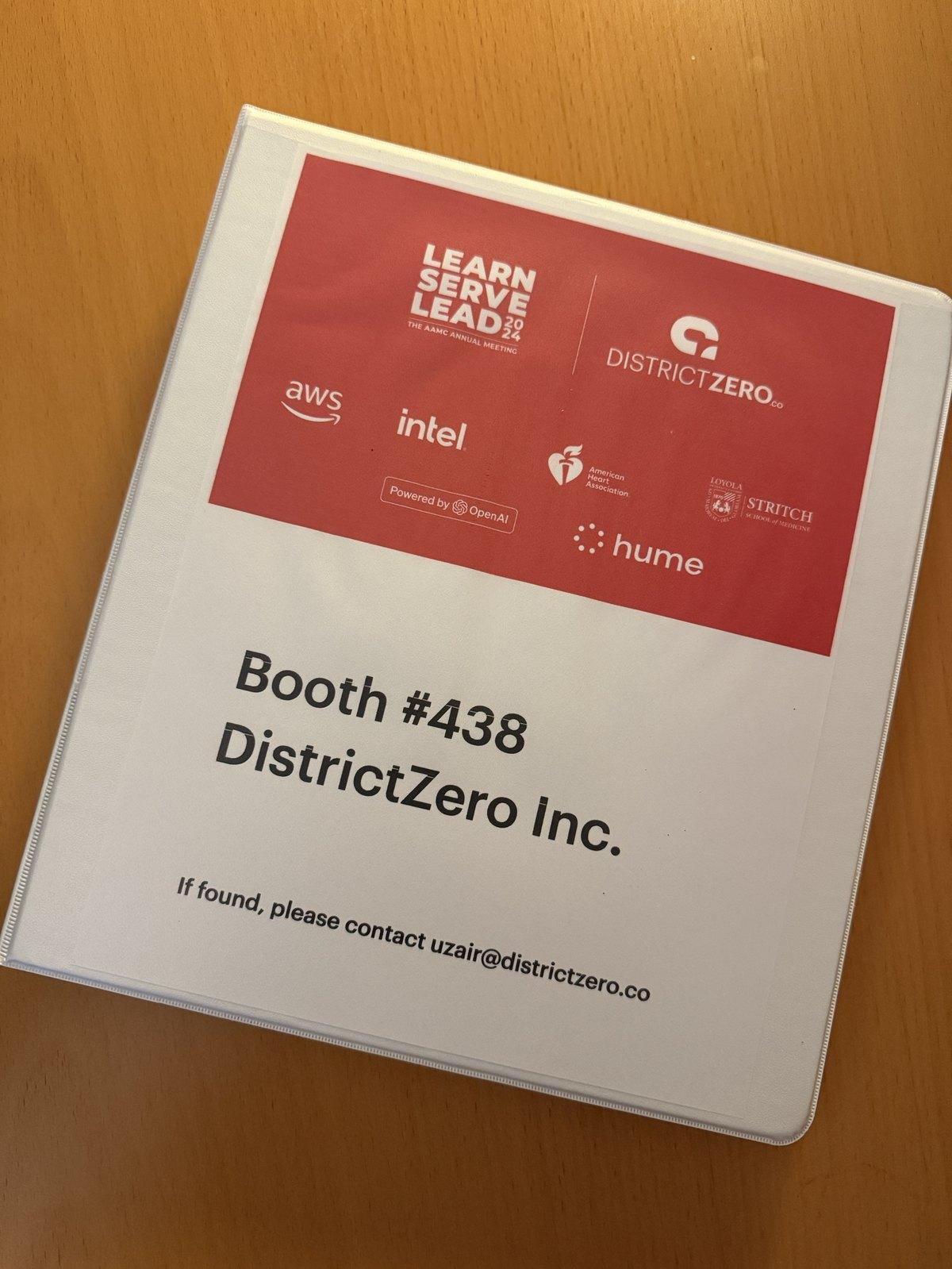
Booth 438 at the AAMC annual meeting.
In November 2024 DistrictZero showed spaced mentorship at Learn Serve Lead, the AAMC's annual meeting, with the Loyola case study in hand. On the exhibit floor, Uzair met Dr. David Skorton, president and CEO of the AAMC.
The debrief
What changed in 20 weeks.
In their own words: what 32 third-year students and their 16 clinician mentors told us at the end of the pilot.
Featured by the AAMCAdvancing AI Resource Collection, for AI in medical education
American Heart AssociationBacked by the Social Impact Fund, 2024
- 86%Reported a significant improvement in well-beingStudents, end of pilot
- 95%Stayed in the program to the endProgram retention
- 90%Found the 60-second agenda generator helpfulClinician mentors
- 85%Reported better emotional awarenessStudents
- 77%Saw their mentee's emotional intelligence growClinician mentors
In their words
“The pilot achieved such positive results that we’re excited to implement DistrictZero across our entire student body.”
Leischner Department of Medical Education, Loyola University Chicago Stritch School of Medicine
“The Discussion Agenda Generator saved immense time by incorporating themes and key points from previous check-ins. This allowed me to focus more on meaningful discussions with my mentees.”
A faculty mentor in the pilot
Loyola Stritch School of Medicine“What makes DistrictZero’s approach unique is that it is not just about access. It also creates efficiencies, increases engagement, and utilizes advanced technology.”
Mark McCoy
Social Impact Fund, American Heart Association
Laps · how it got here
2019
A morning check-in
Born in a design-thinking stand-up with grade 6–8 students.
2021 – 2022
K-12 pilots
A $100K Intel grant, bilingual pilots, and middle, high school and elementary classrooms.
Jan – May 2024
The Loyola pilot
32 students and 16 clinicians, with 32 controls. Funded by the Wallinger Family.
After the pilot
The whole school
Loyola chose to roll it out to every student.